
GLOBAL CLASSROOM STRENGTHENS STUDENTS’ ARGUMENTATIVE WRITING SKILLS
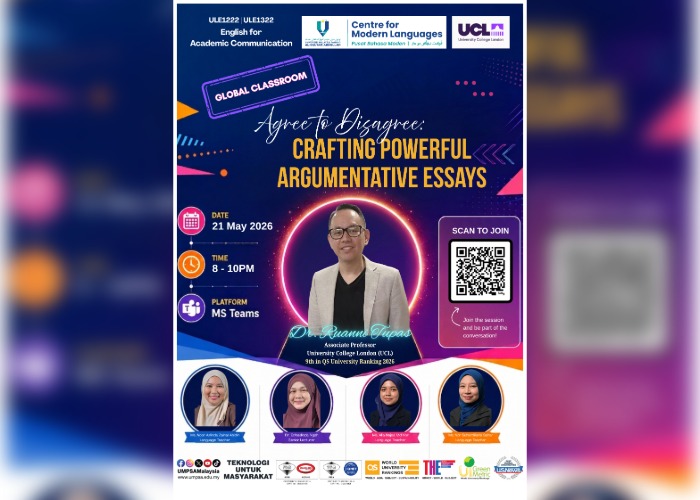
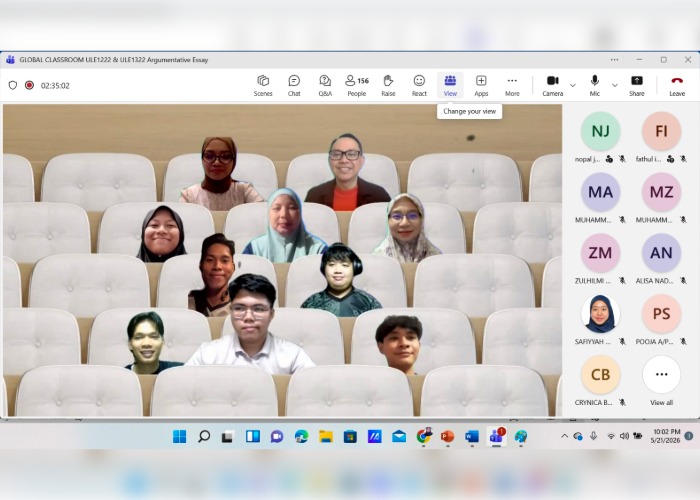
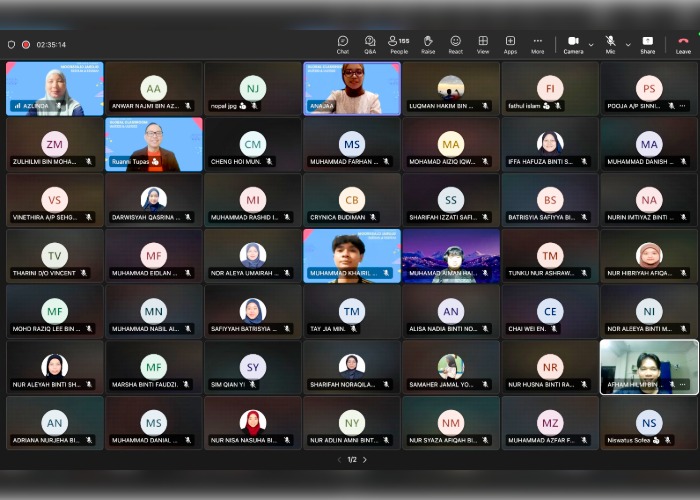
PEKAN, 21 May 2026 – The Centre for Modern Languages (CML), Universiti Malaysia Pahang Al-Sultan Abdullah (UMPSA), successfully organised a Global Classroom session titled “Agree to Disagree: Crafting Powerful Argumentative Essays” in collaboration with University College London (UCL). Conducted via Microsoft Teams, the virtual session brought together engineering students and language educators to explore the role of argumentative writing in academic and professional contexts.
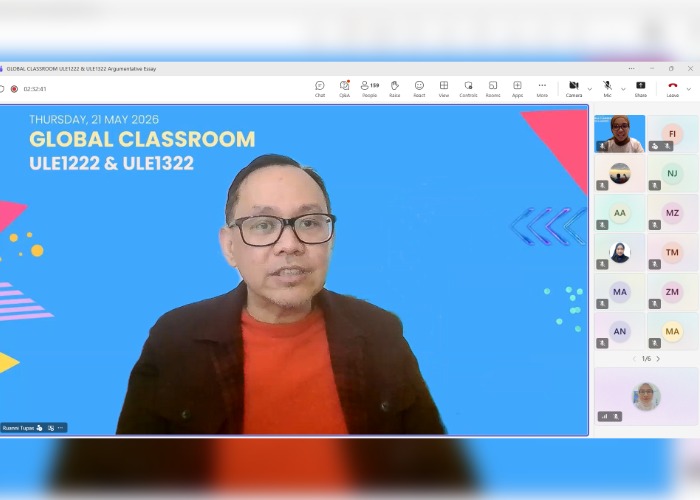
The session featured Associate Professor Dr Ruanni Tupas from the Department of Culture, Communication and Media, Institute of Education, UCL, as the main speaker. He was joined by four instructors of ULE1222 and ULE1322 English for Academic Communication from UMPSA – Noor Azlinda Zainal Abidin, Dr Ezihaslinda Ngah, Alia Najaa Md Nor, and Nor Suhardiliana Sahar.
In his presentation, Dr Tupas challenged the common perception that argumentative writing belongs only to the humanities. Using engineering-related scenarios such as urban flooding, building cooling systems, material selection, and transport planning, he demonstrated how engineers evaluate alternatives, analyse evidence, and justify decisions while considering factors such as cost, safety, feasibility, and sustainability.
The speaker emphasised that argumentative writing extends beyond expressing opinions and involves four key elements: judgement, evaluation, justification, and recommendation. Through practical examples, students learned how to construct well-supported arguments by taking a position, providing evidence, and explaining the reasoning behind their decisions. The session highlighted argumentative writing as an essential professional practice that supports effective problem-solving, responsible communication, and informed decision-making.
Participants were also introduced to the concept of disciplinary argumentation and explored how engineering argumentation differs from writing in other disciplines. Examples drawn from design reports, feasibility studies, environmental impact assessments, and technical proposals illustrated how engineers assess risks, evaluate trade-offs, and justify recommendations before implementation.
Interactive reflection activities further encouraged students to analyse argumentative strategies within engineering texts and examine how evidence is used to support recommendations. The discussions reinforced the idea that engineering writing is closely linked to professional responsibility and real-world problem-solving.
In his concluding remarks, Dr Tupas reminded participants that argumentative writing is more than an academic exercise. Rather, it reflects how engineers evaluate options and justify decisions that ultimately affect communities and the environment.
The session received positive feedback from participants. Nur Aina Naajihah Mohd Azman shared that the session helped clarify her understanding of argumentative essay writing. “Alhamdulillah, I learned more about argumentative essays. Before this, I was actually confused about how to write a good essay, but now I understand it better. The speakers were also very good, and I was able to understand the lecture well,” she said.
Another participant, Anwar Najmi bin Azahari, expressed his appreciation for the interactive question-and-answer session and the opportunity to engage directly with the speaker. He added that the session inspired him to further improve his English language proficiency.
The Global Classroom initiative continues to provide UMPSA students with valuable opportunities to engage with international scholars and gain insights into global academic and professional practices. Through initiatives such as this, UMPSA continues to strengthen students’ communication competencies while fostering global engagement and professional readiness.
Prepared by: Nor Suhardiliana binti Sahar & Alia Najaa binti Md Nor