
THE FACULTY OF APPLIED LANGUAGE STUDIES EMBRACES AI, TECHNOLOGY, AND INTERACTIVE LEARNING BEYOND THE CLASSROOM
PEKAN, 5 October 2026 – The Faculty of Applied Language Studies, Universiti Malaysia Pahang Al-Sultan Abdullah (UMPSA), is embracing artificial intelligence (AI), interactive technologies, and alternative learning approaches to transform how students learn and practise languages, both inside and beyond the classroom.
From customised AI chatbots and interactive writing platforms to immersive technologies, reading initiatives, and tabletop games, the faculty is exploring new ways to make language learning more accessible, engaging, and relevant to students' academic and professional development.
As part of its ongoing development as a faculty, these initiatives also support the development of VOICES, a language hub envisioned as a space where technology, creativity, and human interaction come together to enhance language learning.
Custom AI Chatbots: Bringing Personalised Support into the Classroom
One of the growing areas of innovation is the development of customised AI chatbots designed to support specific courses and learning needs. Rather than relying solely on general-purpose AI tools, instructors are developing course-specific applications that provide students with more targeted guidance and learning support.
These innovations demonstrate how AI can complement conventional teaching by making learning resources more accessible while allowing instructors to devote greater attention to classroom interaction, individual guidance, and meaningful learning activities.
RAWI: Making Grammar More Accessible
For the English for Technical Communication course, instructor Abdul Jalil Abdul Rahim introduced RAWI, a customised chatbot designed to support grammar learning.
Through RAWI, students can explore grammatical concepts, check their understanding, and obtain explanations during classroom activities. The chatbot provides an additional source of support, allowing students to revisit grammar points and seek clarification as they learn.
By incorporating RAWI into lessons, the instructor can focus more attention on facilitating discussions, addressing common language difficulties, and providing individual guidance where needed.
EPC Coach: A Course Companion Available Anytime
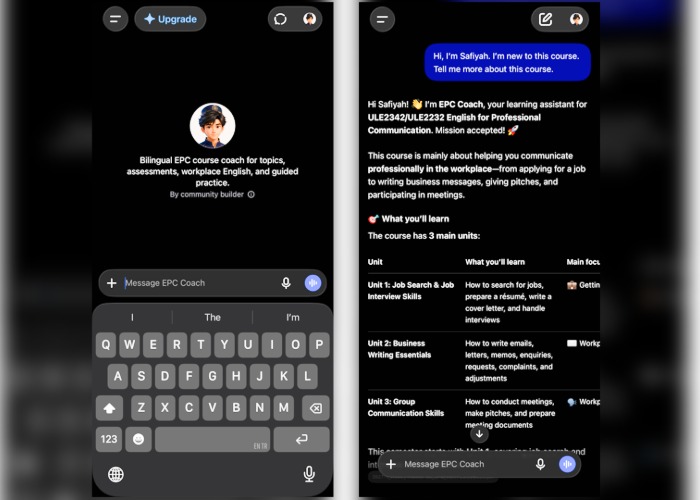
Meanwhile, Wan Noor Farah Wan Shamsuddin, an instructor for English for Professional Communication (EPC), developed EPC Coach, a customised AI chatbot designed to serve as a course companion.
Powered by a GPT model, EPC Coach provides students with convenient access to course-related information, including lecture notes, assessment requirements, class venues, group arrangements, and other learning materials.
The chatbot is particularly useful for students who may hesitate to approach their instructors with questions. It also allows students to obtain information outside regular consultation hours, reducing their dependence on immediate responses from instructors for routine enquiries.
By making essential course information more accessible, EPC Coach supports greater learner independence while allowing instructors to concentrate on teaching, feedback, and student engagement.
IELTS Writing Hub: Understanding How Effective Writing Works
Moving beyond chatbots, instructors are also developing interactive AI-supported learning platforms that guide students through more complex language-learning processes.
For the Score IELTS course, Dr Wan Jumani Fauzi developed IELTS Writing Hub, an interactive platform designed to help learners develop the analytical, organisational, and linguistic skills required for IELTS Academic Writing Tasks 1 and 2.
Unlike conventional IELTS preparation applications that emphasise model answers and memorised writing templates, IELTS Writing Hub focuses on helping learners understand how effective writing works.
Through guided activities, learners analyse task requirements, identify relevant information, notice language patterns, organise ideas, construct sentences, and develop coherent written responses.
The platform includes Task 1 and Task 2 Coaching Academies, a NOTICING Studio, sentence-level writing guidance and AI-supported feedback designed to encourage critical thinking, reflection, and independent improvement.
Built around the principles of noticing, scaffolding and collaborative learning, IELTS Writing Hub supports individual, pair and group activities. Learners progress from examining model responses and discussing writing strategies to constructing and revising their own texts, gradually moving towards more independent writing.
The platform also incorporates opportunities for collaborative writing and discussion, recognising that writing development benefits from interaction, feedback, and reflection.
A planned Socratic AI Writing Coach will further support learners through guided questioning rather than simply supplying answers. The intention is to help learners evaluate their own writing decisions against task requirements and IELTS assessment criteria.
Ultimately, IELTS Writing Hub aims to develop confident, reflective, and independent writers who understand not only what to write, but also why their writing works.
Recommendation Report Buddy: Recommending with Evidence and Confidence
Another innovation developed by Dr Wan Jumani Fauzi is Recommendation Report Buddy, an AI-supported professional learning workspace designed for undergraduate engineering students enrolled in English for Technical Communication.
Scheduled for introduction this semester, the application places students in the role of technical consultants tasked with investigating an organisational problem and recommending an appropriate solution.
Students are guided through the process of identifying organisational needs, establishing evaluation criteria, researching available products or technologies, comparing alternatives, and developing evidence-based recommendations.
The application also supports students as they transform their analysis into a structured recommendation report and professional presentation aligned with course assessment requirements.
Unlike AI applications that generate complete assignments, Recommendation Report Buddy is designed to function as a learning coach and thinking partner. Students remain responsible for investigating problems, evaluating evidence, making decisions, and justifying their recommendations.
This approach encourages students to develop critical thinking, research, decision-making, and professional communication skills alongside their technical knowledge.
More importantly, it reflects the faculty’s growing emphasis on using AI to support learning rather than replace the intellectual effort students are expected to make.
Large Language Model (LLM) Applications in Foreign Language Classrooms
The integration of Large Language Models (LLMs) into foreign language classrooms has transformed the way educators prepare teaching materials and facilitate language learning. AI-powered tools such as Gemini, Claude, ChatGPT, and NotebookLM have become valuable resources for developing lecture notes, interactive presentations, visual materials, and other engaging learning activities.
Beyond content creation, these tools can also support the development of authentic and contextualised language learning experiences. For instance, AI-powered speech generation can simulate native speakers' pronunciation, intonation, and conversational patterns, providing students with additional opportunities to practise their listening and comprehension skills.
According to Mandarin language instructors Lee Cheng May and Kang Mei Feng, the integration of LLMs has significantly enhanced the efficiency of classroom preparation for the Mandarin team. These tools have proven particularly useful in generating diverse teaching resources, allowing instructors to save valuable time and focus more on meaningful student engagement and effective language instruction.
LLMs also enable instructors to customise learning materials according to students' language proficiency levels, learning needs, and classroom objectives. This flexibility encourages more personalised and interactive learning experiences while reducing the time required for lesson planning and material development.
Kahoot!: Making Learning Interactive and Measurable
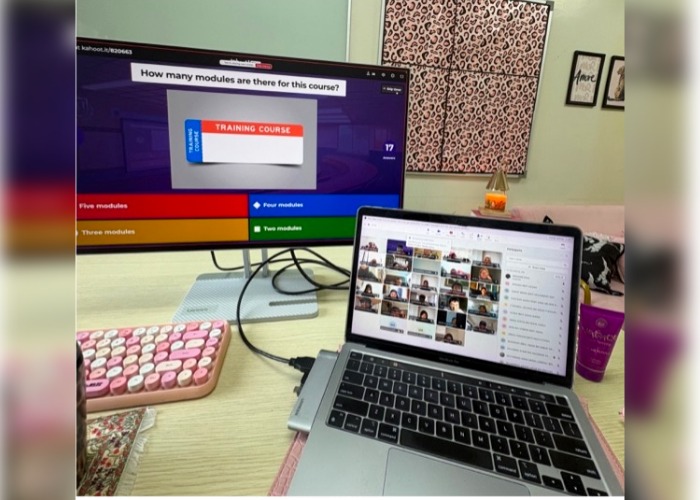
Beyond customised AI applications, Kahoot! continues to be a widely used interactive learning platform across all courses.
Its game-based quizzes, live leaderboards, and competitive features provide opportunities for students to participate actively in lessons while receiving immediate feedback on their understanding.
The platform has also proven useful during online teaching sessions, particularly at the beginning of the semester, when instructors seek to establish interaction and encourage student participation.
In addition to creating a more engaging learning environment, Kahoot! serves as a practical formative assessment tool.
Instructors can review student responses immediately, identify areas of misunderstanding, and adjust their teaching accordingly.
This combination of participation, assessment, and immediate feedback illustrates how relatively simple digital tools can contribute to more responsive and student-centred teaching.
Immersive Learning Through Augmented and Virtual Reality
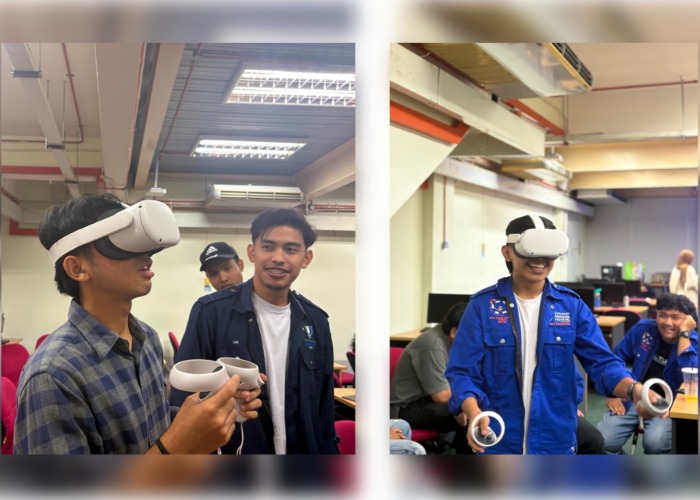
The faculty is also exploring the potential of augmented reality (AR) and virtual reality (VR) to provide students with more contextualised language-learning experiences.
These technologies can place learners in simulated environments such as job interviews, professional meetings, workplace discussions and travel situations, where they are required to communicate in realistic scenarios.
Such environments provide opportunities for students to practise language use beyond textbook exercises and conventional classroom activities.
In an English for Professional Communication class, students who engaged in VR-supported speaking activities reported reduced speaking anxiety, alongside improvements in fluency and accuracy observed during the learning activities.
These experiences highlight the potential of immersive technologies to support confidence-building and more authentic communication practice.
However, the value of such technologies lies not merely in their novelty, but in how effectively they create opportunities for students to use language meaningfully.
This principle also underpins the faculty's efforts to develop physical learning environments where students can interact, communicate, and learn from one another beyond the formal classroom.
VOICES: Extending Language Learning Beyond the Classroom
The faculty’s commitment to innovative language learning extends beyond digital applications and emerging technologies. Recognising that language proficiency also develops through reading, conversation, collaboration and social interaction, the faculty is developing VOICES, a language hub that brings together technology, creativity and experiential learning.
The initiative began with BACAHUB, a community reading corner established to encourage reading and the sharing of books. Built around the concept of “Pick One, Gift One,” BACAHUB allows students to read on-site or take a book in exchange for another, helping to sustain a shared collection of reading materials.
The initiative aims to encourage reading habits while creating opportunities for students to encounter English and other languages outside their academic courses. BACAHUB's growing collection includes books in Malay, English, Mandarin and Korean, together with boxes of books donated by the university library. UMPSA Publisher has also contributed nine language-learning modules covering Mandarin, German, Arabic, Spanish, and Japanese. These modules are available for reference within BACAHUB.
Beyond supporting proficiency in English and other languages, BACAHUB also aims to promote awareness and appreciation of ethnic and heritage languages. Although books in these languages have yet to be added to the collection, efforts are being planned to source suitable materials that reflect Malaysia's rich linguistic and cultural heritage. The initiative recognises that languages are not merely tools for communication but also carry the histories, identities, and traditions of the communities that speak them.
Adding to BACAHUB's identity is a mural created by 17 UMPSA student painters, inspired by the imagery of hundreds of birds returning to their nest. The birds represent curious minds, diverse cultures, and different languages coming together in a shared space for learning.
Adjacent to the mural are dedicated language boards where students can contribute vocabulary, expressions, reflections, and ideas, including activities such as Word of the Day. These features are intended to encourage students to interact with languages in informal and creative ways, extending language learning beyond scheduled lessons.
Learning Through Play: Tabletop Games at VOICES
Building on BACAHUB, VOICES has also expanded to include a dedicated space for tabletop gaming, introducing another dimension to informal language learning. The space offers Euro-style board games alongside familiar titles such as Risk, The Game of Life and Upwords, providing students with opportunities to interact, collaborate and engage in friendly competition.
While the games offer recreational value, they also create situations in which players need to explain rules, discuss strategies, negotiate decisions, solve problems, and respond to one another. Such interactions can provide opportunities for students to practise English and other languages in a relaxed environment where communication serves a genuine purpose. Strategy-based games, for example, encourage discussion, persuasion and decision-making, while word-based games can support vocabulary development and language awareness.
The intention is not to turn every recreational activity into a formal language lesson, but to create an environment where students feel comfortable communicating, experimenting with language, and learning through interaction. By bringing together reading and tabletop gaming, VOICES seeks to make language learning part of students' everyday university experiences rather than an activity confined to the classroom.
Towards a More Connected and Innovative Language-Learning Community
These initiatives reflect the faculty’s broader vision as it continues its transition into a fully established faculty: to create a learning environment that combines technological innovation with meaningful human interaction.
The Dean of the Faculty of Applied Language Studies, Associate Professor Dr Zuraina Ali, expressed her confidence that VOICES would provide greater opportunities for the university community to engage in language learning.
“I am confident that with the establishment of our language hub, VOICES, UMPSA students will gain greater access, more opportunities, and richer resources to engage with the latest technology in their language learning,” she said.
The development of VOICES represents a complementary approach to the faculty's growing use of AI and educational technology.
While AI-powered applications provide personalised guidance, immediate feedback, and opportunities for independent learning, initiatives such as BACAHUB and tabletop gaming create spaces for reading, conversation, collaboration, and cultural exchange.
Together, these efforts reflect the faculty's commitment to preparing students who are not only technologically competent but also confident communicators, critical thinkers, and culturally aware individuals.
As the faculty continues its transformation, its approach to language education remains grounded in a simple principle: technology can enhance learning, but meaningful communication and human connection remain at the heart of language development.
Prepared by: Wan Noor Farah Wan Shamsuddin & Dr Wan Jumani Fauzi