
STRENGTHENING ACADEMIC WRITING THROUGH ETHICAL AI INTEGRATION: A PRACTICAL WORKSHOP FOR RESEARCHERS AND POSTGRADUATE STUDENTS
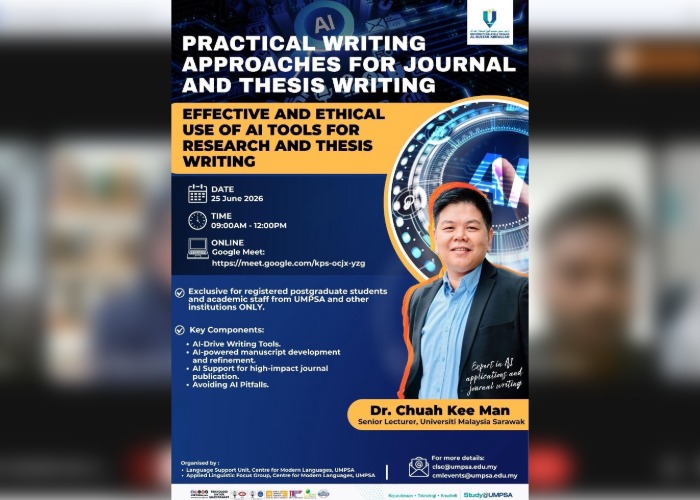
PEKAN, 25 June 2026 - The Centre for Modern Languages, in collaboration with the Language Support Unit and the Applied Linguistic Focus Group, successfully organised an academic writing workshop titled Practical Writing Approaches for Journal and Thesis Writing: Effective and Ethical Use of AI Tools for Research and Thesis Writing. The workshop was held on Thursday, 25 June 2026, from 9:00 AM to 12:00 PM.
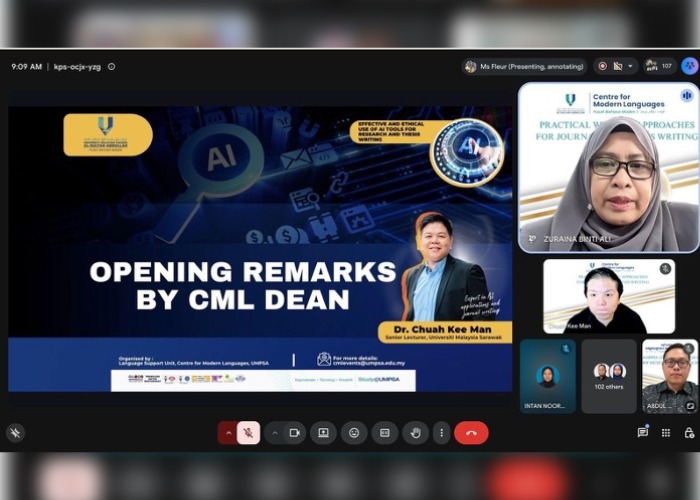
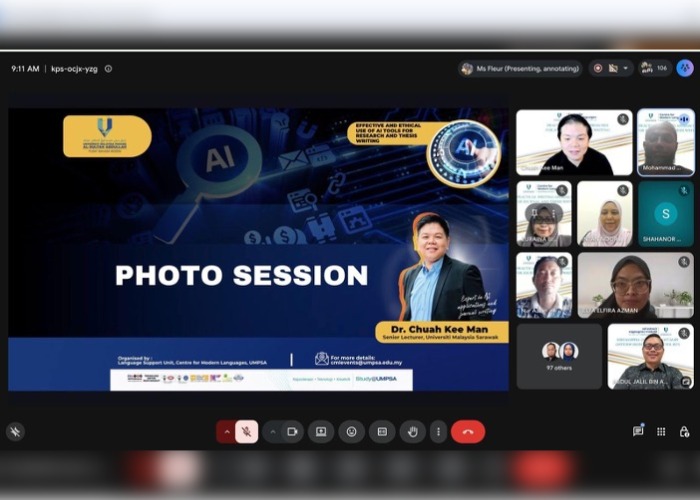
The session was facilitated by Dr. Chuah Kee Man, Senior Lecturer at Universiti Malaysia Sarawak (UNIMAS), who was invited as the guest speaker. The workshop brought together 123 participants, comprising university lecturers, researchers, postgraduate students, and external participants from various higher education institutions. In support of UMPSA’s ongoing international collaboration initiatives, faculty members and students from Universitas Tanjungpura (UNTAN), one of UMPSA’s partner institutions, were also specially invited to participate in the online workshop.
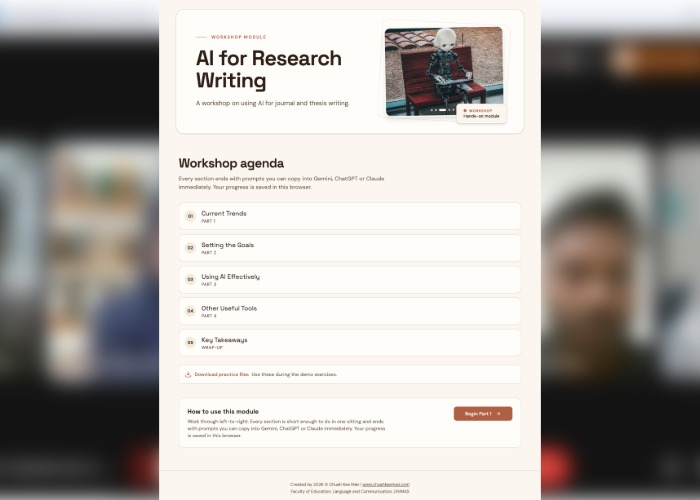
Structured as an interactive and hands-on session, the workshop focused on practical approaches to integrating artificial intelligence (AI) into academic writing while upholding academic integrity. Dr. Chuah introduced several widely used AI platforms, including NotebookLM, Gemini, ChatGPT, and Claude, and demonstrated how these tools can support different stages of journal article and thesis writing.
Participants were provided with practical guidance on formatting AI-assisted content, refining AI-generated text through manual editing, and using free AI tools strategically to enhance writing productivity despite token limitations. The workshop also introduced selected premium AI platforms and examined how such tools can help reduce researchers’ writing workload while improving overall efficiency.
One of the key highlights of the workshop was the session on customising personal AI writing styles and developing reusable prompt templates tailored to individual research needs. Throughout the session, Dr. Chuah underscored the importance of balancing technological efficiency with responsible academic practice, particularly in relation to the ethical use of AI in scholarly writing.
The workshop received highly positive feedback from participants, who commended both the depth of the content and its practical relevance. Many participants also expressed interest in future advanced workshops on AI-assisted research and academic writing. Beyond its training objectives, the event served as a valuable platform for academic exchange among educators, researchers, and postgraduate students from diverse institutions and disciplines.
Overall, the successful implementation of the workshop reflects the Centre for Modern Languages’ continued commitment to supporting academic excellence and advancing innovative approaches to research communication. In view of the encouraging response, the organising team intends to conduct similar programmes and extended training sessions on emerging AI technologies and academic writing practices in the future.
Written by Wan Raihan Wan Shaaidi and Lee Cheng May